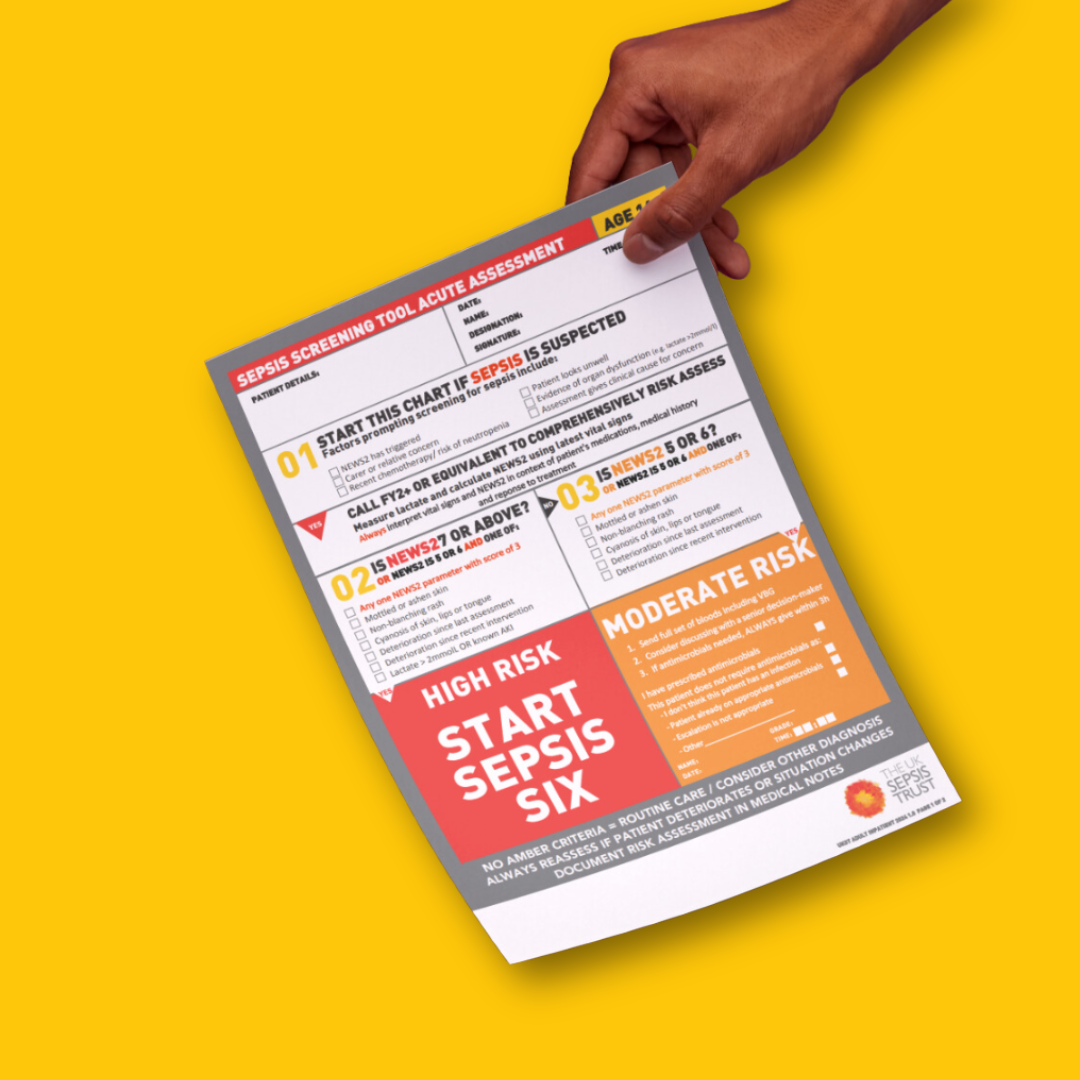
Today, NICE announced a number of important changes to their guidance, all of which impacts on sepsis care in healthcare settings. As a result, the UK Sepsis Trust has updated its clinical toolkits – which are free and available to any healthcare professional – to reflect these changes.
Overall, these updates mean that we’re one step closer to the entire NHS managing and talking about sepsis in the same way – something that will enable delivery of care to be coordinated and seamless throughout different settings. This has potential to be transformational for our patients – if resource can be allocated to help deliver.
Who are NICE?
NICE – or the National Institute for Health and Care Excellence – is the independent body that provides evidence-based guidance on all things to do with the NHS, including treatments and diagnostics. NICE guidance can set standards of care, and they adjust and modify their guidance whenever new evidence comes to light. Every time this happens, the UK Sepsis Trust works very closely with them to make sure any relevant changes are reflected in the tools we deliver to busy health professionals on the ground.
As a result of this close collaboration, UKST’s clinical toolkits are recommended by NICE.
What are the NICE sepsis guidance updates?
The latest guidance updates revealed three important changes which relate to sepsis care:
- It reminds health professionals that there are a large number of people who are particularly at risk of sepsis, and that list has expanded. This means that they have a better understanding of which patients to be particularly vigilant around sepsis.
- It reminds health professionals of the importance of listening to the patient, their family, carer or other advocates – particularly in patients who might communicate differently, such as those with learning disabilities, neurodiversity, or for those who don’t speak English as their first language.
- As well as reminding health professionals to use NEWS2 (the National Early Warning Score) in acute health settings to identify people who are unwell and might be deteriorating with sepsis, NICE is encouraging health professionals to think much earlier about giving vasopressors.
Many people with sepsis develop low blood pressure – or other markers – which suggests that their organs aren’t receiving enough blood: this is septic shock. An essential part of treatment for these people is intravenous fluid resuscitation, and now, NICE wants health professionals to think much earlier in this process about giving drugs called vasopressors. Vasopressors, given by an infusion, work by increasing blood pressure and can improve blood supply to vital organs. Although we support this change and agree on the evidence space, the challenge the NHS will need to overcome is that currently patients on these infusions can only be cared for in an Intensive Care Unit, which means there is likely to be more demands than ever for Intensive Care beds
The NEWS2 for non-pregnant adults is already rolled out across the NHS, but over the next 12-18 months, we anticipate the Maternity Early Warning Score (MEWS) and Paediatric Early Warning Score (PEWS) will also be rolled out, and this will be reflected in any future updates to NICE guidance.
How has UKST reacted to these updates?
Our clinical toolkits, which have been designed in consultation with NICE, have already been updated following the new guidance update and are suitable for immediate adoption. This includes all toolkits – in any setting – that relate to people aged 16+. Our clinical toolkits are aimed at healthcare professionals and provide the optimum balance between saving lives from sepsis and a responsible approach to antimicrobial stewardship.
Dr Ron Daniels BEM, Founder and Chief Medical Officer at UKST, says: “We look forward to a situation where the entire NHS is managing, identifying, and escalating people with sepsis in the same way, using the same language, and we’re getting ever closer to that. We strongly recommend that all NHS facilities review and adopt our clinical tools, as recommended by NICE, with immediate effect.”
If you’re a health professional and would like to access our clinical toolkits, you can download them below.