
Nick Bladen, 62, from Hampshire, was living with Stage 4 Polycystic Kidney Disease when he underwent surgery for high-grade prostate cancer in March 2023. Just ten days after what had been deemed a successful operation, he developed life-threatening sepsis and an acute kidney injury; a dangerous combination for someone whose kidneys were already severely compromised.
During National Kidney Month in March, Nick is sharing his story to highlight how chronic kidney disease can increase vulnerability to infection, and how sepsis does not always present with a high temperature, particularly in people with compromised immune systems.
Nick had been under close surveillance for prostate cancer since 2019. In February 2023, routine tests revealed the disease had progressed from low grade to high grade, with two tumours in the prostate and one outside it.
He opted for a radical prostatectomy on 7 March 2023. “The operation itself was a huge success,” Nick said. The following week his catheter was removed, “a huge relief”, and he began pelvic floor exercises as part of his recovery.
But on 17 March, a few days after the catheter was removed, he began to feel strange.
“I suddenly started to feel incredibly cold, and then thirty minutes later incredibly hot with profuse sweating,” he said. His temperature was only slightly raised. Family members assumed it might be flu or perhaps a developing urine infection. The following day, the episodes intensified but were still intermittent.
“The extreme hot and cold feeling with uncontrollable shaking was the trigger to highlight something was not right,” Nick said. “When I say extreme, I really do mean extreme. No matter how many blankets I had on me, I was frozen, with totally uncontrollable shakes. Within thirty minutes it flipped to extreme overheating and profuse sweating.”
Despite these dramatic symptoms, his temperature remained “normalish” – something that falsely reassured Nick’s family. His family thought they were fairly healthcare savvy, but they just weren’t in tune with the possibility of sepsis – suspecting an infection such as UTI instead.
When they returned to the private hospital where he had undergone surgery, the seriousness of the situation quickly became apparent once fully assessed. Although he had walked himself into reception, his blood pressure had dropped to 70/50.
He was urgently transferred to Southampton General Hospital and admitted directly to intensive care. Tests confirmed E. coli infection, rigors, acute kidney injury… and sepsis.
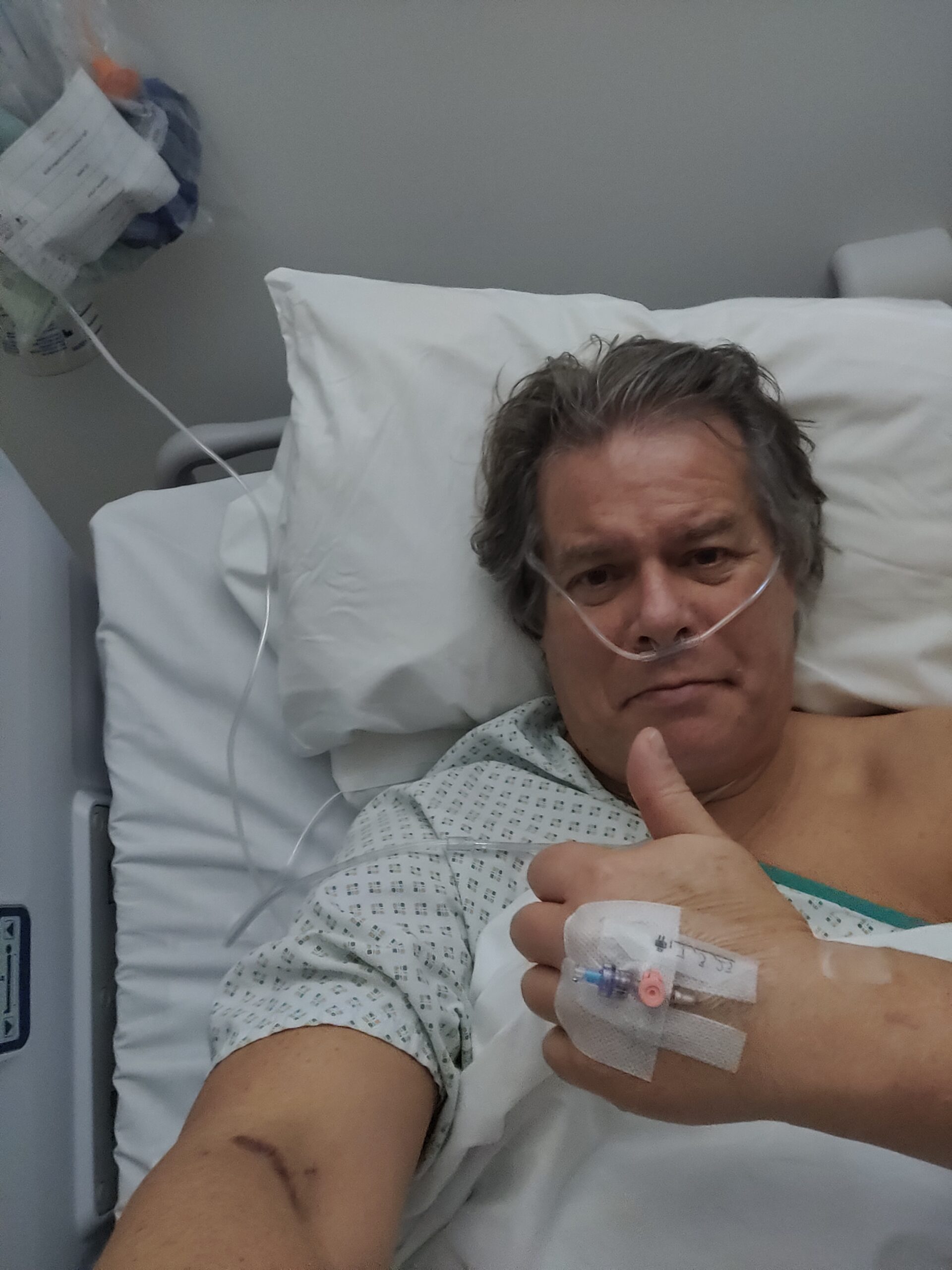
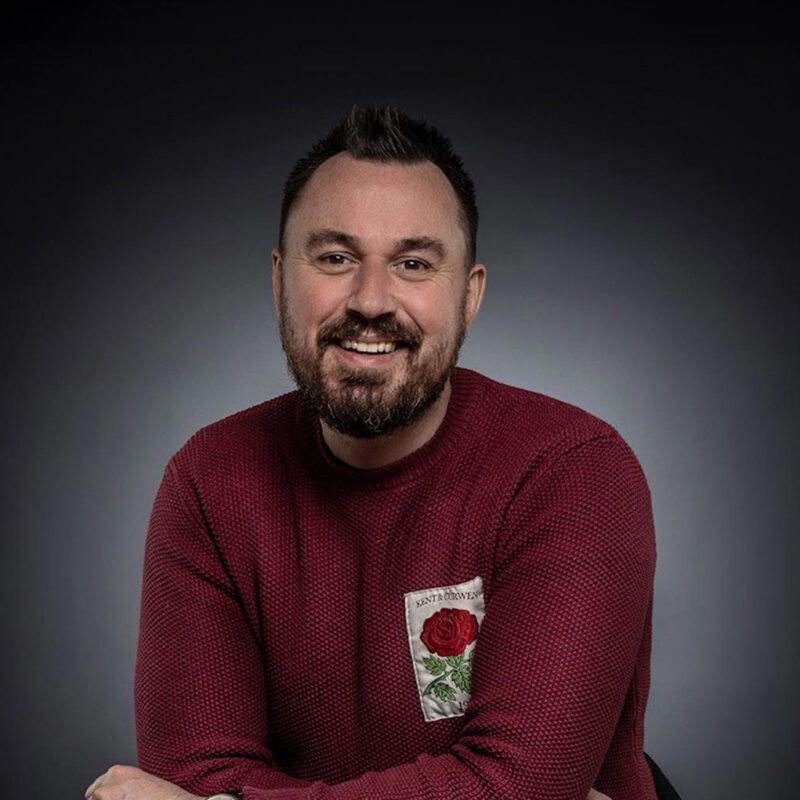
Nick after his prostatectomy procedure
For Nick, who already had Stage 4 Polycystic Kidney Disease (PKD), the diagnosis carried particular weight. His kidneys were enlarged and filled with cysts rather than functioning tissue, making them vulnerable.
“I was a complicated case,” he said. “The cysts may already have been harbouring infection before the prostatectomy, perhaps bursting at some point around the time of the operation.”
In ICU, Nick was placed in isolation.
“Then it dawned on me that I was in ICU,” he said. “I didn’t actually feel that bad, but people were constantly checking me over, so something must have been seriously wrong.”
Nick had known very little about sepsis beforehand: “I believed it was a killer infection, but I had absolutely no clue how people contract it, how it impacts people, or even if it was possible to recover.”
The cancer he had been focused on just days earlier faded into the background. “The cancer operation became a distant memory,” he said. “My focus completely switched to the present prevailing position.”
The rigors persisted for weeks. “Never in my life have I sweated like this,” he said. “My bed often had to be changed during the day due to the pools of sweat amassing on the mattress.”
Despite intravenous antibiotics, Nick’s recovery was slow. He lost three stone in six weeks and struggled to eat. Chronic diarrhoea from medication compounded his weakness. By early May, he was still suffering ongoing infection and was readmitted for further investigation.
“At the time I was comforted by the fact that detailed biological investigations were taking place,” he said.
Eventually, targeted antibiotics were identified and administered via a PICC line, allowing him to receive daily treatment at home for 30 days. Throughout his illness, Nick adopted what he describes as “fight mode.”
“My youngest son was due to be married on 1 July 2023,” he said. “I kept saying to myself, you must get better for the wedding. My simple focus was to make sure I made it.”
As time ticked down, he visualised recovery.
“The other focus when lying in a hospital bed was to imagine I was on a hot sunny beach, waves lapping at my feet,” he said. “Transporting my mind elsewhere took me away from the confines of hospital wards.”
There were emotional moments too – listening to Stevie Nicks sing ‘Landslide’ or Christine McVie sing ‘Songbird’ would bring tears – but he refused to dwell in despair. “There was no time to feel sorry for myself,” he said.
His final antibiotic dose came just days before the wedding.
“I count my blessings every day,” Nick said. “Firstly that I made the wedding, a superb and joyous day, and secondly that I am still here today.”
Nick is inordinately grateful to everyone involved in his care: “The support, care and intensive care I received from all people treating me, was second to none. I feel eternally grateful to every single person who has been with me on this journey, health professionals, family, friends and work colleagues. They might not know it, but they all played a vital part in keeping me alive and driving me on in such a traumatic period of my life.”
Nick had regular blood tests and ongoing checks with his renal team to ensure the sepsis and infection had gone. He was alerted by the team that it could easily take hold again and he would be more susceptible to sepsis in the future, so it was important to be on alert to any/all symptoms.
While he wasn’t signposted to UK Sepsis Trust at the time for mental health support after leaving hospital, Nick considers himself to be “pretty mentally resilient”, with a glass always “three quarters full” approach to life. “But if you do feel like you need support, definitely reach out to the UK Sepsis Trust,” said Nick.
Looking back, he believes his relatively normal temperature masked the severity of his illness: “My fairly normal temperature kept throwing me off – it made me and my family think it couldn’t be too serious when it really was.”
For people living with chronic kidney disease, Nick believes greater vigilance is essential, particularly around major surgery. “Maybe blood tests to check for infection markers prior to any surgery could help reduce risk, especially for someone with PKD,” he said.
Now three years on, cancer-free, living with stage 5 PKD and about to start dialysis with an eGFR of 5, but crucially without recurrence of sepsis, Nick urges others to understand the full range of symptoms and not delay seeking help.
“Always listen to your body,” he said. “Don’t be afraid of seeking help early.”
During National Kidney Month, his message is clear: for those living with kidney disease, infections can escalate rapidly. Awareness, early recognition and prompt treatment can mean the difference between life and death.
Don’t delay – learn the signs of sepsis today by getting #SepsisSavvy